-
11 Jan – loud ringing.
Today I was woken up at 5AM by incredibly loud ringing in my right ear and headache. It’s weird that ringing can be so loud it wakes me up from sleep, even when I know it’s just in my head. It’s not a real sound.
It’s been there all day (now 4pm). Around 900kHz and again at 1800kHz. What does that mean?I’m not sure. Is this a side effect of hearing improving or reducing. I have no idea. But My ear is again extremely sensitive today so I’ll wait out the day and see what tomorrow brings.
I have absolutely no hearing of notes between D6 (1175Hz) and A6 (1790). Anything between around 1100 and 1800 I just hear it as one tone at 1800. And if I try to turn it up in my right ear enough to hear it, I only hear it in my left ear.
This is the deafest that ear has been since this started. I can’t listen to music at all as I hear it in the wrong ear.
I am trying the best I can do with the CIST, listening of a bit of music trying the frequency training, but it’s hard.
-
‘Don’t waste your cancer’
I was reminded over the Christmas break by a book by John Piper called ‘Don’t waste your cancer.’ One of the phrases was:
We waste our cancer if we spend
too much time reading about cancer and
not enough time reading about God.Very true!
I have been doing a lot of reading about SSHL and CIST lately, and it has been very beneficial, but I’m hooking into the Bible a bit more too and that has been deeply encouraging.
You can download John Pipers little book for free from here:
https://www.desiringgod.org/books/dont-waste-your-cancer
Personally I think point 3, while true, needs to be nuanced by the fact that this world is under God’s curse. It’s true that we are not cursed by God. But we still live in a cursed world and the effects of the curse impact us directly, even though God now uses them of our good. I waste my cancer if I’m not reminded of the brokenness of this world and outraged by it!
But I love this book – it’s incredibly helpful.
-
CIST day 4
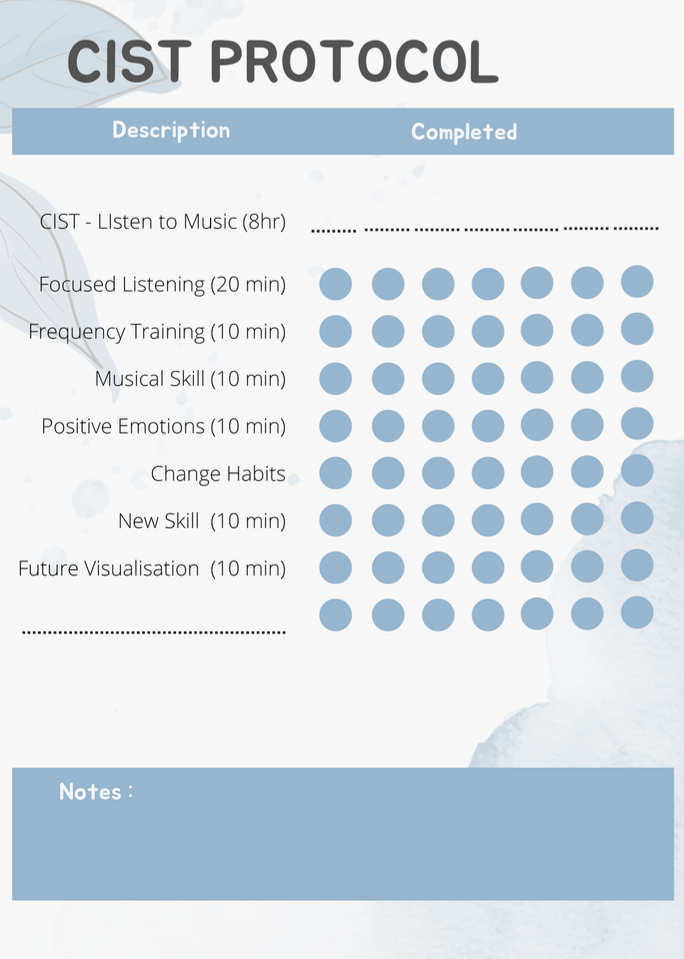
I have been doing my new strict CIST Protocol for 3 days.

Well mostly.
I managed 8 hrs audio the first day but 6 the following 2 days.
And I’ve forgotten to do the ‘change habits’ and I still haven’t worked out what positive emotions means exactly, but working on it!
Here’s my hearing graph.

6 Jan was day 1 of new strict CIST Protocol. A very gradual increase since then…
To put things into perspective, here is my complete graph since day 1 of SSHL.
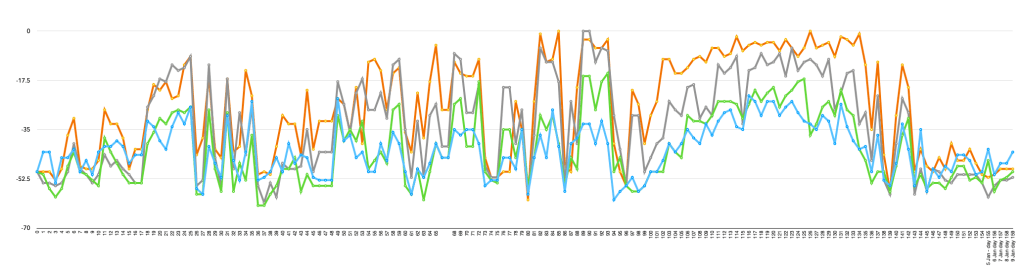
So I am a long way down but at least the direction is upwards once again! -
Today I start this!
-
What an irritated ear feels like
Today my ear is in a ‘half irritated’ state. It’s not the worst, but it’s not good. But I need to document this so that later I don’t forget what it’s like. I think when my hearing is good I forget what it was like to be bad, and I get a bit lazy about being careful. So, self, this is what it feels like to have a half bad ear:
- Ear is ringing, not extreme but about the volume of normal speech.
- Ear feels ‘blocked’ – like there is water in deep.
- Ear feels ‘warm to hot’
- Ear feels tight and irritated and this feeling extends to the bottom of my neck, half way into my head, almost to my nose, and up to my temple.
- Any above average sound (person talking, dishes, door closing) causes a mild pain and a flinching reaction.
This is what it’s like at the circle below.
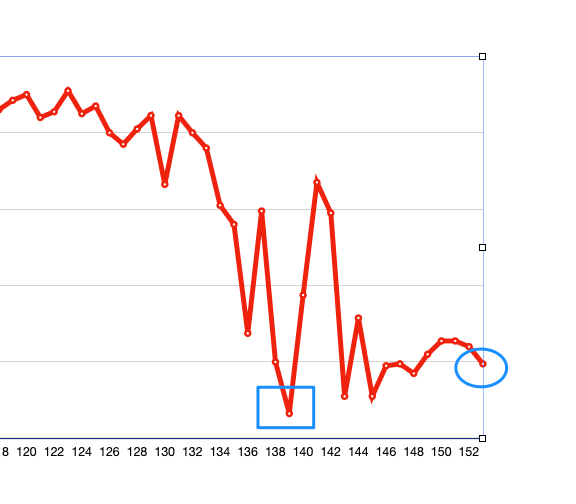
There’s a big difference between today (I would call irritation) and the square 2 weeks ago.
So what did the ‘square’ feel like? All the above plus:
- Ear is ringing so loudly that it wakes me up and stops me getting to sleep.
- Strange noises in my head like a a very loud heartbeat, and noises I think I’m hearing when they are not there.
- Ringing causes a constant headache.
- Any sound with my ears unplugged in unbearable, I need to block my ears and head outside if anyone talks, closes a door, starts the kettle, turns on the washing machine.
- I can’t type on the keyboard without headphones.
Even yesterday was noticeably better than that. I could live with yesterday.
Yesterday I spend about 1hr in quiet conversation outside after dinner with family, I was expecting it to go OK, as it was nice and subdued. But that set me back a little today by the looks of it.
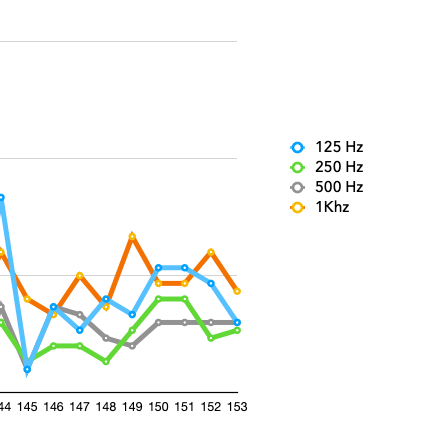
Over the next 3 days I will aim for 4 hours of music listening a day even though it sounds bad and see if it makes any difference. I still havn’t started my CIST protocol, psyching myself up!
-
1st Jan 2024
It’s a new year and I’ve decided to really tackle this hearing thing. I’ve been reading a lot and today I wrote 2 papers which I will post on the front page.
One is about the Stages of SSHL to give me language to use, the other is is called CIST Protocol and I’ll be sticking to this as closely as I can in the New Year!!
Today my hearing has improved ever so slightly. Midnight Oil and Cold Chisel still sound off. Stryper is kind of OK. Crowded house is good.
-
Ernie and Bert singalong.
When my hearing is bad it’s hard to find any music to listen to, it all sounds off.
Some is worse than others. it may have something to do with the frequencies in the music, but I think it’s got more to do with how deep in my brain it is. Stick with me!!
I thought I would really enjoy Sons of Korah, but it’s way off. I’ve only known of them for 15 years.
Midnight oil is OK. Crowded house too. And Stryper. they are all bands I listened to in the 80’s.
But since before Christmas when my hearing crashed nothing sounds any good. So yesterday I tried something from my childhood. Yes Spotify actually had the Sesame St Ernie and Bert sing along. And yes, it actually sounded OK. ‘Old Mc Donald had a Farm’ etc
My guess, it’s from when I was 5-10 years old, it’s so deep in my brain it can’t hear it wrong.
I have listened to U2 ‘Where the streets have no name’ many more times. But even that sounds a bit off.
So if you find me listening to Harry Belafonte ‘Banana Boat’ don’t panic. I’m just having a bad hearing day.
-
30 Dec – seem to have settled
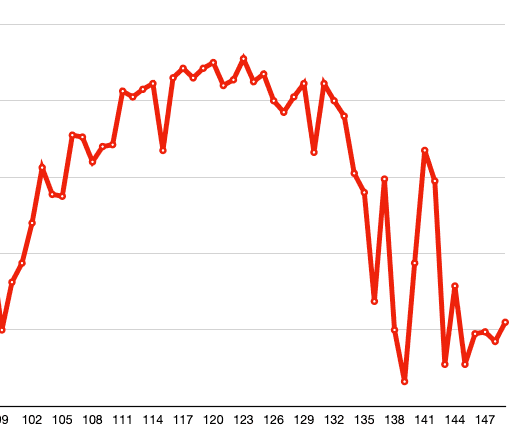
Today I had the slightest increase in hearing. I can’t perceive it but the graph is slightly up.
It looks like the latest up and down wobble bit is over, which is nice because the wobble bit after a crash seems to be when my ear is most painful.
It feels like the pre Christmas crash from Dec 15 is finally over and I am on the mend again. If so, that took 2 weeks.
My ears are not ringing for the first time in 10 days which is nice!
And I can almost hear the pure tone in a tone sweep all the way from 30Hz to 1kHz. There’s just a tiny place around 800Hz where I can’t make out the tone at all.
Bono sounds almost OK but Crowded House not so good.
-
SSHL – more than a hearing problem
In 1 week I will have had SSHL for 6 months. I had no idea that my hearing 6 months would be just as bad as the day it all started. I had no idea that a month ago my hearing would be almost back to normal and then drop again.
All the literature and my own ENT specialist talk about improving, but none of them talk about going backwards.
So the last couple of days I wrote this summary of my thinking and the way my understanding has grown about this problem that I have.
”A new approach to SSHL needed? (pdf)
Here’s the text of the article:
Brain Plasticity and SSHL – a new approach needed.
Wayne Connor Dec 2023
Brain Plasticity and SSHL – a new approach needed.
Wayne Connor Dec 2023
I have had Sudden Sensorineural Hearing Loss (SSHL) for just under 6 months. SSHL is defined as greater than 30dB of hearing loss in greater than 3 frequencies in under 3 days. It’s a sudden deafness in one ear.
The longer it goes on the more I’m realising there’s a problem in the way the medical world approaches this condition. Currently all kinds of hearing disorders are lumped together under the heading of ‘SSHL’.
The cause can be anything from a viral infection (including COVID) to a blood flow problem, or trauma, autoimmune disorders, stress, or the side effect of other medications. Moreover the location of the cause of the SSHL can vary: the cochlea hair cells, or the nerves that connect the cochlea to the brain, or the brain itself, including the higher level auditory cortex. Not to mention each of those areas can be broken down into more detail.
One audiologist may say ‘be careful with loud noises’ because if the damage is to the cochlea hairs, of course you want to protect them from further damage. But if the problem is that the auditory cortex is confused, it may actually need stimulation to repair itself. So the generic term SSHL at that point is not helpful.
Diagnosing someone with SSHL is about as useful as saying ‘your car won’t start’. One car might be fixed with a new battery. Another by changing the spark plugs, and another by filling the car with fuel. Sure, the WD40 might help wherever you spray it, but after you’ve sprayed it everywhere, what next?
The standard treatment (the WD40 of SSHL) is steroids. Prednisolone apparently targets all the areas potentially involved in SSHL. It can assist if the hair cells are damaged, reduce inflammation anywhere along the pathway from the chochlea to the brain, and it suppress the immune system which may be damaging the hair cells or nerves. But what if the steroids don’t work, or only partially restore the hearing. Here lies the big problem, with such a broad diagnosis (SSHL) how can you begin to treat it?
In Australia the problem is exacerbated by the specialising of doctors into areas. So there may be an Ear, Nose and Throat specialist, an audiologist, or a neurologist, but who of those best deals with SSHL? It’s like my car won’t start, but do I go to an auto electrician, or a carburettor specialist?
As my SSHL has progressed I suspect it’s become, or always was, neurological. By that I mean the problem has moved from the inner ear (if it as ever there, but I suspect that it was) to my brain.
If you take a look at my hearing graph on my blog, it is very erratic. My ENT said SSHL doesn’t go backwards, and my audiologist said my hearing shouldn’t swing so far daily like that. Which leads me to conclude that perhaps it’s the brain causing the problem, not the ear.
The most recent theories out there are that when the brain stops receiving signals from one ear, it re-wires itself somewhere in the signal chain to listen to the other ear – your good ear. The signals from each ear travel into the brain and are combined at several points, in the brain stem but finally in the auditory cortex. The way this happens is very complex. When your brain receives no input from one ear, it can re-wire itself to stop listening to the bad ear. Studies show this happening within 72 hours of hearing loss. When 3 or 4 days later, your ear heals, it’s possible that your brain is so re-wired that it’s stopped listening to that ear. It’s like being put on hold on a phone for so long that you hang up. The brain has ‘hung up’ on your ear.
My suspicion is this is why they say that SSHL is a medical emergency. It needs to be treated in the first 72 hours. It’s possible that the physical condition needs treatment in the first 72 hours. But it’s also possible that 72 hours is how long it takes the brain to re-wire itself. So the 72 hour window might be critical to fix the physical condition before the brain re-wires. This explains why some people can regain hearing after 72 hours. The brain can re-wire itself. It’s just harder. It also explains why the more severe the hearing loss, the more likely it is to be permanent. If the loss of hearing in the deaf ear is greater than the cross-hearing (50dB), then any sound into the bad ear will in reinforce the ‘bad’ wiring.
One proposed treatment for this is called CIST. To encourage the brain to re-wire itself back again you stimulate the bad ear with music.
The idea was introduced in 2014
“Constraint-induced sound therapy for sudden sensorineural hearing loss – behavioral and neurophysiological outcomes”
Okamoto,Fukushima et al. 2014
This paper from 2016 explains it in more detail:
“Neuro-rehabilitation Approach for Sudden Sensorineural Hearing Loss”
Sekiya, Fukushima
These papers found no improvement from CIST:
Neuroplastic Effect of Constraint-Induced Music Therapy on Hearing Recovery in Patients with Sudden Sensorineural Hearing Loss. (2019)
Effect of Constraint-Induced Music Therapy in Idiopathic Sudden Sensorineural Hearing Loss: A Systematic Review and Meta-Analysis (2022)
These studies found improvements using CIST:
Effect of Combining Sound Therapy with Pharmacotherapy on the Recovery of Hearing Abilities in the Case of Sudden Sensorineural Hearing Loss: A Prospective Study (2022)
Sound therapy in sudden deafness (in Spanish) M.A. López-González (2017)
So it’s a bit hard to know is CIST helps, but it’s certain there is a brain plasticity issue.
What is CIST? (Constraint-induced sound therapy)
CIST is a therapy that combines standard medical treatment (like corticosteroids) with auditory stimulation. The idea is to force the brain to pay attention to the affected ear by plugging the healthy ear and listening to music or other sounds through headphones on the deaf ear for several hours a day. This increased stimulation is believed to promote neuroplasticity, the brain’s ability to reorganize and adapt, which could help to recover hearing and prevent auditory deprivation.
“Scientists are testing a new way to treat sudden hearing loss. It’s like how they help stroke patients regain movement: by forcing the brain to use the affected part. Here’s how it works for hearing:
- Plug the good ear. This makes the brain focus on the ear that’s not working well.
- Listen to music in the bad ear for 6 hours a day. This gives the brain lots of sound to work with, kind of like exercising the ear.
The goal is to:
- Stop the brain from giving up on the bad ear. When hearing loss happens, the brain can start to ignore the bad ear and focus on the good one. This new therapy tries to prevent that.
- Help the brain rebuild connections to the bad ear. This could help people hear better again.
[Constraint-induced sound therapy for sudden sensorineural hearing loss – behavioural and neurophysiological outcomes 2014]
The following articles explain all this in a bit more depth: I’ve used Google Bard to help summarise some of these papers. T
Brain rewiring in SSHL
Normally, sound triggers stronger brain activity in the opposite side of the brain. When one ear loses hearing, this still happens for the deaf ear. But for the good ear, the brain acts differently: it relies more on the same side instead of the opposite.
[“Healthy-side dominance of cortical neuromagnetic responses in sudden hearing loss” (An-Suey Shiao)]
Brain rewiring in SSHL
The brain reorganises itself after hearing loss in order to compensate for the loss of hearing. The ipsilateral dominance observed in this study is a new finding and could have implications for understanding and treating hearing loss.
[“Healthy-side dominance of middle- and long-latency neuromagnetic fields in idiopathic sudden sensorineural hearing loss “(2006)]
Higher level brain rewiring in SSHL
Sudden hearing loss can affect the brain, not just the ears. The brain may try to adapt by changing its activity patterns. More research is needed to understand these changes and develop better treatments.
“The advancement of imaging technology has revealed that individuals with SSHL exhibit not only alterations in brain cortical and subcortical structures but also associated with changes in brain functional activities involving various brain networks such as the default mode, auditory, executive control, and visual networks.”
[Altered static and dynamic intrinsic brain activity in unilateral sudden sensorineural hearing loss – August 2023 Frontiers in Neuroscience 17]
SSHL and the Auditory Cortex
“SSHL affects neural activity not only in the cochlea, but also in the auditory cortex. Several neuroimaging studies suggested that SSHL induced cortical plasticity in the human auditory cortex within a few days of its onset. Moreover, the degree of cortical reorganization represented by the loss of contralateral hemispheric dominancy of the auditory evoked fields appeared to negatively correlate with recovery rates from hearing loss. The cortical plasticity induced by the onset of SSHL may be considered as maladaptive for the hearing capability of the affected ear. Therefore, the prevention of this maladaptive cortical reorganization associated with SSHL may represent a new treatment strategy.”
[Neuro-rehabilitation Approach for Sudden Sensorineural Hearing Loss 2016]
Brain learns not to hear.
Maladaptive cortical reorganization refers to changes in the auditory cortex that can occur after SSHL. These changes are thought to be harmful and may contribute to the difficulties some people experience in recovering their hearing. The exact cause of maladaptive cortical reorganization is unknown, but it is thought to be related to changes in brain activity after the inner ear is damaged. Maladaptive cortical reorganization can lead to the “learned non-use” of the affected ear, meaning the brain stops paying attention to sounds coming from that ear. This can make it harder to recover hearing and can also lead to tinnitus.
[Neuro-rehabilitation Approach for Sudden Sensorineural Hearing Loss January 2016 Journal of Visualized Experiments 2016(107)]
Can we reversing the Brian re-wiring?
Cortical structures in the adult human brain were previously considered to be non-elastic; however, recent studies have revealed that the adult brain can be reorganized based on its surrounding environment and behavior. Reorganization in the human auditory cortex generally occurs in a direction that is preferable for fulfilling demands; however, it may also induce pathological phenomena in the auditory system such as tinnitus. Therefore, it appears to be important to develop suitable neurorehabilitation approaches to treat maladaptive reorganization in the auditory system.
[“Investigating the maladaptive cortical reorganization in the human auditory cortex using magnetoencephalography” 2020]
Spanish Trial
The study by López-González et al. (2017) investigated the efficacy of a new treatment for sudden sensorineural hearing loss (SSNHL). The treatment consisted of acoustic stimulation with sounds delivered through headphones for one month. The results showed that the treatment group had a significantly better hearing recovery than the control group. At the end of the study, the mean hearing improvement in the treatment group was 20 decibels (dB), compared to 4 dB in the control group. The authors concluded that acoustic stimulation is an effective treatment for SSNHL. The treatment is especially effective when it is started early.
Summary in English of the study by M.A. López-González et al. (2017)
Google Bard can you give me a simple explanation of ‘Maladaptive cortical reorganization’ (Note this is just a summary of the information available to Google Bard, it’s not intelligent at all)
Maladaptive cortical reorganization is a fancy way of saying that the brain rewires itself in a way that actually causes problems rather than helping.
Imagine your brain is like a city, and the streets are connections between different parts. When you suddenly lose hearing, it’s like a major road closure – the sounds that used to travel to your auditory area (the hearing neighborhood) can’t get through anymore. Now, the city doesn’t like empty streets, so it starts rerouting things. When the ear tries to send a signal again, it hits a traffic jam of a dead end.
This rewiring can also lead to problems like:
- Phantom sounds: Hearing sounds that aren’t actually there, like ringing or buzzing in the ears (tinnitus).
- Speech in noise problems: Having difficulty understanding speech in noisy environments.
Here are some things that can be done to help prevent or reverse maladaptive cortical reorganization:
- Early intervention: The sooner you start treatment for hearing loss, the less likely it is that your brain will have time to rewire itself in a maladaptive way.
- Sound therapy: Listening to sounds through the affected ear, like music or white noise, can help to keep the auditory cortex active and prevent it from being taken over by other sensory areas.
- Brain training: There are some new brain-training programs that are being developed to help people with hearing loss learn to use their brains more effectively to process sound.
-
Measuring hearing Quality
Something I want to document about my hearing. The hearing tests that the specialists do don’t capture everything that’s going on. The hearing tests measure how loud you can hear each frequency, but they don’t indicate the quality of the hearing.
I mean sometimes my wife sounds like a Dalek from Dr Who, music sounds terrible, out of tune, notes sound like the wrong note, a guitar sounds like a piano, and I can’t tell what some sounds are. (I have to ask “What’s that noise” – “Oh, you mean the fridge?”)For the past 3 days any noise I hear between about 200 and 600 Hz all sounds the same. If I press notes on a keyboard app that is generating a sine wave every note sound the same.
If were to do an official hearing test, it would register me as having good hearing at 250Hz. But what the hearing tests don’t show is that my ear/brain is not differentiating and different in the tones of 250Hz and 500Hz.
It could be that the doctor’s don’t care about that, because the levels at each frequency give a good enough indication of the health of the hearing. Or it could be they are unaware.
Anyway I did 2 plots yesterday, one is of the sound volume level I am hearing, and one is of the sound quality.
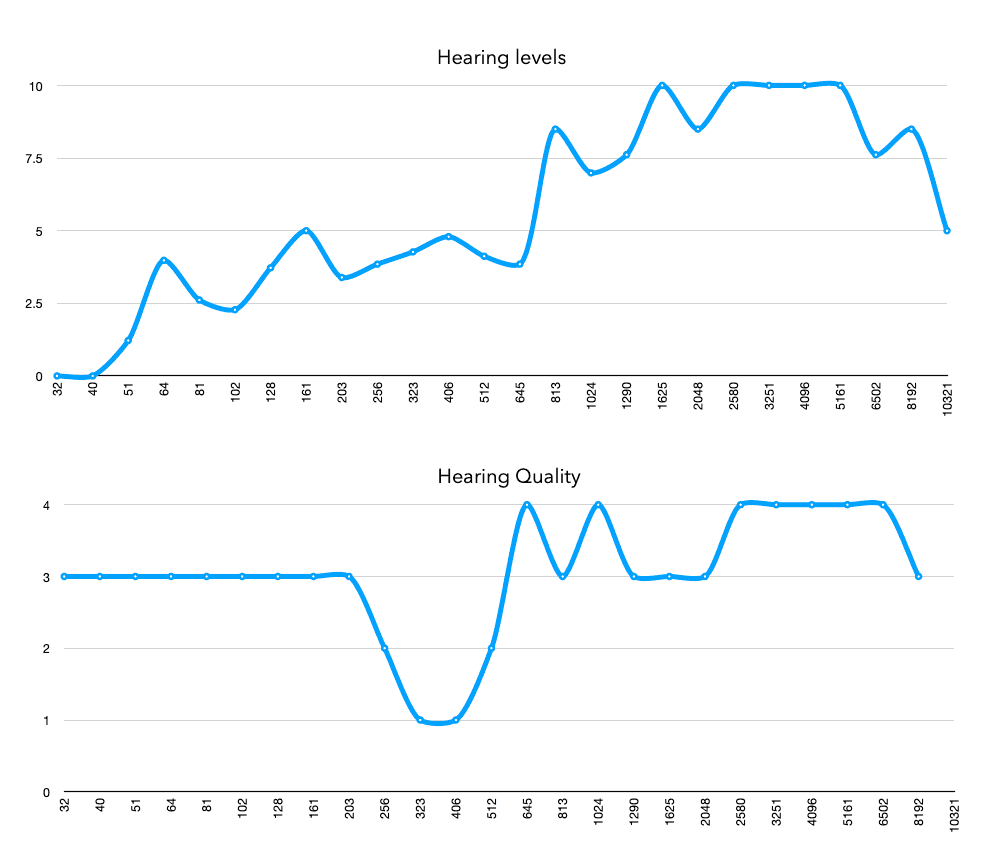
The top graph has the usual shape of my hearing tests, worse at the left, better high, but the bottom graph is slightly different. I did this hearing level above manually, without an app, using a sine wave generator, so that I could track more frequencies. (32,40,51,64 etc instead of just 125Hz,250Hz etc). The official tests have big gaps between the frequencies being measured.
The second graph shows the ‘Quality’ of hearing. I gave each frequency a quality score from 1-4.
My worst ‘quality’ of hearing is from 200 to 800Hz.
My worst actual hearing is below 200Hz, but it sounds clear.
I actually prefer the loss of hearing to the bad hearing.
For the frequencies around 400Hz, then I turn them up they sound all wrong. Out of tune. Like a Dalek. Underwater. The hearing tests do not measure this. But I can hear it in my head.I can also measure it by doing a frequency sweep from say 100Hz to 1000Hz. This is where you play a single note and slowly increase the frequency of it. I can hear a single tone increasing in frequency up until about 200Hz, then the tone disappears and I hear one massive noisy tone overwhelming everything else, my guess is it’s around 400Hz but it’s hard to tell. Then, when the rising pure tone hits around 700Hz, the strange tone disappears and I can hear the individual tone slowly rising again and by 800Hz it’s clear again. At 300Hz-600Hz the background noise is so bad I lose the single tone altogether.
The third way I can hear this loss of quality is if I play a scale on a piano app that is playing a sine wave. The notes from C4 (262Hz) up to C5 (523Hz) are almost indistinguishable – they all sound like the same note. To help improve this I am playing myself songs in this scale, and trying to imagine what they should sound like.
I am playing ‘I am not done changing’ which covers C,D,E,F
I am playing ‘Amazing Grace’ which is so familiar to me from a young age so I can ‘hear’ (imagine) the notes even when my ear is not hearing them and try to force/train my ear to heat them properly. Amazing Grace also has a good message so that encourages me!
Twinkle Twinkle little star has a simple melody and is also well known from a young age so it’s a strong memory.
Joy to the World just goes form C down to C, hitting every note – so it’s very useful!
Today I was able to isolate the ringing to exactly 320 Hz and an octave up at 640 Hz. By playing it back into my ear while I was writing this article it seems to have mostly gone!
-
December 25
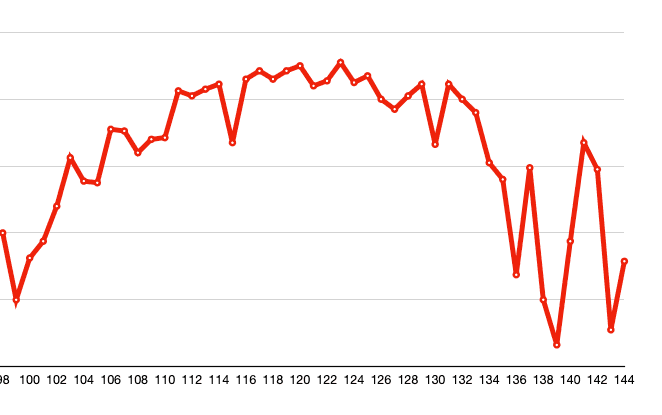
It’s days like today I am very thankful for doing my graphs! I woke up with a headache and bad ringing in my ears, and very deaf. I was woken up early by loud ringing my ears and couldn’t get back to sleep. Then I was irritated by the sound of everyone being joyful on Christmas so I had to go outside. How do I be around family on a day when they are so happy they will all be talking?
As I was saying, the graph is helpful because even though it FEELS worse today, the graph tells my my hearing has actually improved since yesterday. So staying at home and doing nothing yesterday helped. This is psychologically important for me to see and notice the small improvements, because I’m not a great one to look at the big picture, whether that’s eternity, or 10 years, or next year. Instead I easily get stuck in the moment!
So there’s 3 things that I remind myself.
In the now – there is some improvement – but even if there wasn’t that’s OK – God still has things in his control.
In the medium term – I know there is an upward trend in my hearing, and it’s possible that in 6 month I will be better.
In the long term – this life is short and there is an eternity waiting with a new creation where hearing loss or any other problems will no longer be there. So all this is temporary!
Something I want to document about my hearing. The hearing tests that the specialists do don’t capture everything that’s going on. I wonder if they realise this, or they are unaware. But the test measure how loud I can hear at each frequency, but they don’t indicate what the quality of the hearing is. For the past 3 days any noise I hear between about 200 and 600 Hz all sounds the same. If I press notes on a keyboard app that is generating a sine wave every note sound she same. If I measure my level at 250Hz, or 500 Hz, it registers at hearing, But what the hearing tests don’t show is that my ear/brain ins not differentiating between 250Hz and 500Hz. It could be that the doctor’s don’t care about that, because the levels at each frequency give an indication of the health of the hearing, and it doesn’t matter that 250 and 500 sound the same. Or it could be they are unaware.
Anyway I did 2 plots yesterday, one is of the sound volume level I am hearing, and one is of the sound quality.
The top graph has the usual shape of my hearing tests, worse at the left, better high, but the bottom graph is slightly different. The worst quality of hearing is from 200 to 800Hz. Even though my hearing below 200 low volume, what I do hear is clear, so if I turn the bass up it sounds good.
Btu for the frequencies around 400Hz, then I turn them up they sound all wrong. Out of tune. Like a Dalek. Underwater. The hearing tests do not measure this. But I can hear it in my head.I can also measure it by doing a frequency sweep from say 100Hz to 1000Hz. This is where you play a single note and slowly increase the frequency of it. I can hear a single tone increasing in frequency up until about 200Hz, then the tone disappears and I hear one massive tone, my guess is it’s around 400Hz but it’s hard to tell, then when the rising note hits around 700Hs I can hear it slowly rising again and by 800Hz it’s clear again. At 300Hz-600Hz the background noise is so bad I lose the single sign wave altogether.
The third way I can hear this is if I play a scale on a piano app that is playing a sine wave. The notes from C4 (262Hz) up to C5 (523Hz) are almost indistinguishable – they all sound like the same note. To help improve this I am playing myself songs in this scale, and trying to imagine what they should sound like.
I am playing ‘I am not done changing’ which covers C,D,E,F
I am playing ‘Amazing Grace’ which is so familiar to me from a young age so I can ‘hear’ (imagine) the notes even when my ear is not hearing them and try to force/train my ear to heat them properly. Amazing Grace also has a good message so that encourages me!
Twinkle Twinkle little star has a simple melody and is also well known from a young age so it’s a strong memory.
Joy to the World just goes form C down to C, hitting every not so it’s very useful!
I also did this hearing level above manually, without an app, using a sine wave generator, so that I could track more frequencies. (32,40,51,64 etc instead of just 125Hz,250Hz etc). That’s because the tests have big gaps and I can tell that my hearing is up and down between the frequencies being measured. For example here it drops around 600Hz then up at around 800Hz then down at 1000Hz, by what I estimate to be 20 or 30dB. It takes too long to measure like this each day but I wanted to see what was happening!
Today I was able to isolate the ringing to exactly 320 Hz and an octave up at 640 Hz. By playing it back into my ear while I was writing this article it seems to have mostly gone!
Happy Christmas everyone. I am thankful that my ear has mostly stopped ringing. I think I am ready to face the day.
-
Deaf again from the lawn mower.
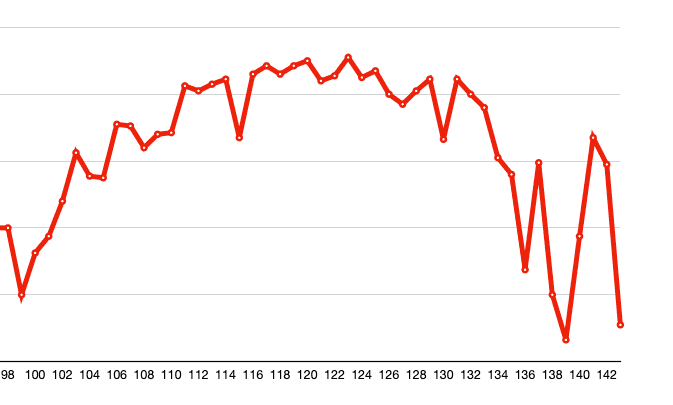
No I didn’t do the mowing! But we had the mower going yesterday to mow the lawns and I was around (with headphones on) doing gardening.
I woke up this morning with bad ringing and finding it hard to hear. I just did my hearing test which confirmed my suspicions. After 3 good days I’ve gone almost deaf again! So what happened? Yesterday morning we did some gardening and the kids were using the lawn mower and whipper snipper.
I had headphones on but I could still hear the mower sounds mildly.
My hearing was pretty good so I had lunch and dinner with the family.
Last night we were up at the church setting up some fairy lights.
So that included a car trip, and there were some conversation going on while we were setting up the lights.
On reflecting, that was a big day for my ears. Too big. I need to be more careful when my ears are good to prevent them crashing again.
This means today I’ll need to be by myself, eat by myself, and try not to have any conversations.
-
Rest brings improvement!
I’ve had a very quiet week living mostly by myself out in the granny flat away from noise and doing nothing.
Tonight I ate dinner with the family for the first time in a week. It was sooooo nice to be back inside. We had risotto, home made beef sausages, roasted vegetables, and good conversations.
I could hear all pure tones from 30Hz to 12kHz, a bit of noise around 500Hz but not so much that it drowned out the main sine wave.
This is the first time since last Sat (6 days) that I can hear all frequencies clearly.
And all the music I was listening to sounded as it should.
My actual hearing levels are still way down, but what I’m hearing is good.
Very thankful.
-
Bono no longer sounds like a Dalek
As you can see from this graph, I’ve had a very bad week with my hearing. The worst it’s ever been.
For the last 5 days Bono sounds like a Dalek, Cold Chisel sound out of tune, Midnight Oil is missing all it’s melody, and Crowded House sound like they are underwater.
But today Bono’s voice is back to normal! So things are looking up.
-
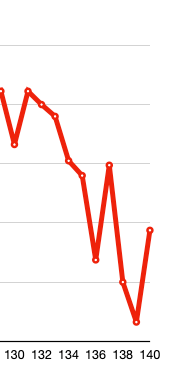
Crash #5 Day 138

Well the graph says it all. My new plan started day 96. (The borrow left of the nice looking mound on the right of the graph.) I decided to be very careful about my hearing. Listening to music 4-6 hours a day. Limiting myself to 1 hour of conversation a day. It seemed to be working very well.
On 30th November (Day 119) about the peak of that nice smooth hill I went for my 3 monthly checkup to the ENT.
Needless to say he was very happy with my progress.
I had 3 questions for him.
- How can I stop my hearing from dropping again?
- How careful should I be about noisy situations?
- What could be causing my hearing to drop?
I guess I was most interested in questions 3. In once sense I know what causes it to drop – going to a meeting, going to church, going to a coffee shop.
But what about those situations causes my hearing to drop?
Is it the multiple conversations?
Is it my talking?
Is it the background noise?
Is it just the noise level?
Why does a conversation cause my hearing to drop but listening to music doesn’t?
The ENT had no answers at all. He was sceptical of my graph. He said with what I have, my hearing doesn’t go backwards! My hearing was now better. I didn’t need to be careful at all.
This sounds strange, but I wanted to believe his words. So over the next couple of weeks I started being less cautious, having more conversations. Tentatively at first, but it gained momentum. I wore my headphones less, and I stopped listing to music as much. I tried to live more ‘normally’.
It was hard to see at the time, but looking back on the graph now it’s obvious. After my visit to the ENT my hearing went from improving to declining. The curve tells the story. It’s like I was coming down a hill I’d just climbed. But I failed to notice it at the time.
The big crash came on day 135-138.
On day 133 I had a practice for our church carols. (This is where the hill turns into a cliff on the graph at the top right,) I think in hindsight if this was all that I did my hearing may have bounced back. But this was followed up on day 135 with a wedding. I was feeling confident after what the ENT had told me and was ‘pushing’ things to see if my ear would hold out.
On day 136 I could tell things were not good. My ear was feeling bad and blocked again. But the damage was done. And it takes a day or two for the effect to appear. The next 2 days I stayed at home to give my ear some rest, but it continued to crash.
And now it’s as bad as it ever was. My ear is in pain. It’s hard to describe how aggravating the ear is. I can’t be in a conversation again or it hurts. I feel like I want to poke a pencil through my eardrum to stop the ringing. (Only I know that won’t stop it!) The ringing is so loud I can’t sleep. If you have SSHL you’ll know what I mean.
I am looking back at my graph thinking why did I do this?
Why did I listen to the specialist when I had a gut reaction he was wrong?
I don’t think the ENT has much of an idea of what’s going on. But also a professional can’t trust a person’s home measurements. If he did he’d be in trouble. He can only go on the professional hearing test results. And they didn’t show my hearing drops as the tests were done when I was at the top of the hill.
I’m going to have to put in a bit more work reading up on how to manage this!
-
Subscribe
Subscribed
Have a WordPress.com account? Log in now.

